Imagine opening Google Analytics on a Monday morning.
Your website traffic is up.
Organic search is looking healthy. Your latest blog post is attracting visitors. People are landing on your service pages, exploring your website, and clicking through to your contact page.
On paper, things look promising.
Then you open your inbox.
Three backlink pitches. Two suspicious submissions. An offer for cheap SEO services. A message from someone selling something your business doesn't need.
And somewhere in that mess, perhaps, is a genuine customer.
Suddenly, the numbers on your dashboard don't feel quite as exciting.
Because here's a question worth asking:
What if your website is getting more attention but not generating more business?
It isn't necessarily a traffic problem. It could be a conversion problem, a targeting problem, a lead-quality problem—or a combination of all three.
And contact form spam can make the situation even harder to understand.
1. The Traffic Trap: More Visitors Don't Always Mean More Customers
Website traffic is one of the easiest marketing metrics to celebrate.
The graph goes up. The report looks better. Everyone feels like the strategy is working.
But traffic measures visits, not business opportunities.
A visitor could be a potential customer researching your services. They could be a student looking for information, a competitor checking your website, an automated crawler, or someone who landed on your page by mistake.
Not every visitor has the same intentions.
This doesn't mean traffic is unimportant. Without relevant visitors, your website has fewer opportunities to generate enquiries.
It simply means traffic needs context.
For example, imagine two businesses:
Business A
5,000 monthly website visits
20 genuine enquiries
Business B
2,000 monthly website visits
35 genuine enquiries
In this hypothetical example, Business B attracts fewer visitors but generates more genuine enquiries.
That doesn't automatically mean Business B has the better overall marketing strategy. Revenue, customer value, conversion quality, and acquisition costs still matter.
However, it illustrates an important point: raw traffic alone cannot tell you how effectively your website creates business opportunities.
The real question isn't just how many people arrive.
It's what happens after they do.
2. Your Analytics Dashboard Might Be Telling an Incomplete Story
Analytics tools are incredibly useful, but they measure what they're configured to measure.
A session is not a qualified lead. A page view is not a sales conversation. A button click is not a signed contract.
And a form submission event doesn't automatically prove that a genuine customer has contacted you.
Depending on your tracking setup, a form event might fire when someone clicks Submit—even if validation fails—or when a submission succeeds, regardless of the message's quality.
Poorly configured tracking, automated activity, and irrelevant submissions can all complicate your interpretation of performance.
This is why it's important to understand exactly what your reports represent.
Ask yourself:
Does our form conversion event record successful submissions or simply button clicks?
Are duplicate events being counted?
Do we have a reliable way to distinguish genuine enquiries from spam?
Are we measuring qualified leads, or only the number of submissions?
Can we connect enquiries with the outcomes recorded by our sales team?
The more clearly you answer these questions, the more useful your analytics become.
A dashboard is only as meaningful as the events and definitions behind it.
3. The Contact Form Is Where Marketing Meets Reality
Your website can attract the right audience, communicate your value, and persuade visitors to take action.
But the contact form is where interest becomes an actual message.
It's also where things can get messy.
A business might receive submissions from:
Potential customers requesting a quote.
Existing customers asking for support.
Agencies pitching backlinks or guest posts.
Companies promoting unrelated services.
Automated scripts submitting junk messages.
People sending vague or irrelevant enquiries.
All these messages can enter through the same doorway.
If your reporting simply counts every successful submission as a lead, the results can become misleading.
Imagine reporting 50 form submissions to your manager. It sounds like a productive month.
But after reviewing the messages, you discover that 18 are spam, 12 are irrelevant enquiries, and only 20 are potential customers.
Suddenly, the headline figure needs explaining.
These numbers are illustrative, not industry benchmarks. Your actual results will depend on your website, audience, and protection measures.
The important distinction is that a form submission is an event; a genuine lead is a business opportunity that still needs qualification.
4. Contact Form Spam Can Distort More Than Your Inbox
Most people think about contact form spam as an email-cleaning problem.
That is only part of the picture.
Depending on your tracking setup, spam submissions can also complicate your understanding of conversion performance.
Consider a campaign that sends visitors to a landing page.
The campaign generates 1,000 visits and 40 recorded form submissions. At first glance, the conversion rate appears to be 4%.
But what if 15 submissions are unwanted messages?
If all 40 represent successful, unique submissions, and 15 are classified as spam, the rate of genuine enquiries is 25 out of 1,000 visits, or 2.5%.
The original 4% figure isn't necessarily technically incorrect. It measures all recorded submissions against visits. But it doesn't tell you the genuine-enquiry rate.
That difference matters when evaluating campaigns, comparing landing pages, or deciding where to invest your marketing budget.
Spam doesn't automatically invalidate your analytics. Rather, it can make certain metrics less useful unless you distinguish between raw submissions and genuine opportunities.
And that's a much better reason to improve form protection than simply wanting a tidier inbox.
5. Why Filtering Every Suspicious Message by Hand Doesn't Scale
When a website receives only a handful of submissions each week, manually checking them might be perfectly manageable.
But as your business grows, the workload can change.
More advertising means more visitors. More visibility can mean more enquiries. And a publicly accessible contact form can attract unwanted submissions alongside genuine interest.
Your team then faces a familiar routine:
Open the message.
Read it.
Decide whether it's relevant.
Delete it or forward it.
Repeat.
The individual task seems small, but repetitive work consumes attention and interrupts other responsibilities.
It can also encourage people to skim messages rather than assess them carefully.
That creates an uncomfortable trade-off: the more time your team spends dealing with unwanted submissions, the less time it has available for activities that move the business forward.
Manual review still has a place, particularly for uncertain messages. But it doesn't have to be your only line of defence.
A more sustainable approach combines sensible form security, automated filtering, and human oversight where needed.
6. CAPTCHA Isn't the Same as Lead Qualification
CAPTCHA can help defend against certain automated form submissions. Other measures, including honeypots, rate limiting, and server-side validation, can also contribute to form security.
But preventing automated activity and identifying useful enquiries are different jobs.
Consider this message:
"Hi, we provide premium backlinks to help your website improve its Google rankings. Would you like to see our packages?"
It might have been written by a real person.
It might even pass a human-verification challenge.
But if your business never requested backlink services, it probably isn't a sales lead.
The reverse is also true: a genuine enquiry might contain a URL, unusual formatting, or wording that triggers a basic spam rule.
That's why a single signal rarely tells the entire story.
Good form protection should consider multiple indicators and, where possible, the intent and context of a message.
It should also allow for uncertainty. Automated detection can make mistakes, so businesses need a way to review suspicious submissions and recover legitimate messages when necessary.
The objective is not to block everything that looks unusual.
It's to reduce unwanted noise without creating unnecessary obstacles for real customers.
7. Measure the Numbers That Actually Matter
If you want to understand how well your website generates business, go beyond sessions and raw submissions.
Start building a clearer picture of the journey from visitor to customer.
Here are five useful measurements to consider.
1. Genuine enquiry rate
How many website visits result in genuine enquiries?
Define what counts as a genuine enquiry and use consistent tracking.
2. Spam submission rate
What proportion of reviewed submissions are classified as spam?
Use a clearly defined sample or the complete set of submissions for a given period, and distinguish confirmed spam from uncertain cases.
3. Lead qualification rate
Of the genuine enquiries received, how many meet your business's criteria for a potential customer?
A genuine message isn't automatically a qualified sales opportunity.
4. First-response time
How long does it take your team to respond to a genuine enquiry?
Tracking this can help reveal whether inbox clutter or internal processes are delaying follow-ups.
5. Lead-to-customer conversion rate
How many qualified leads eventually become customers?
This connects your website's performance with actual business outcomes rather than stopping at the contact form.
You don't need a complicated dashboard to begin. Even a simple monthly spreadsheet can help you understand where the process is working and where it needs improvement.
The key is to define your metrics clearly and compare them consistently.
8. Make Your Contact Form Work Smarter with SpamForms
Your contact form should make it easy for potential customers to reach you.
It shouldn't require your team to spend every morning separating relevant messages from unwanted pitches.
That's where SpamForms comes in.
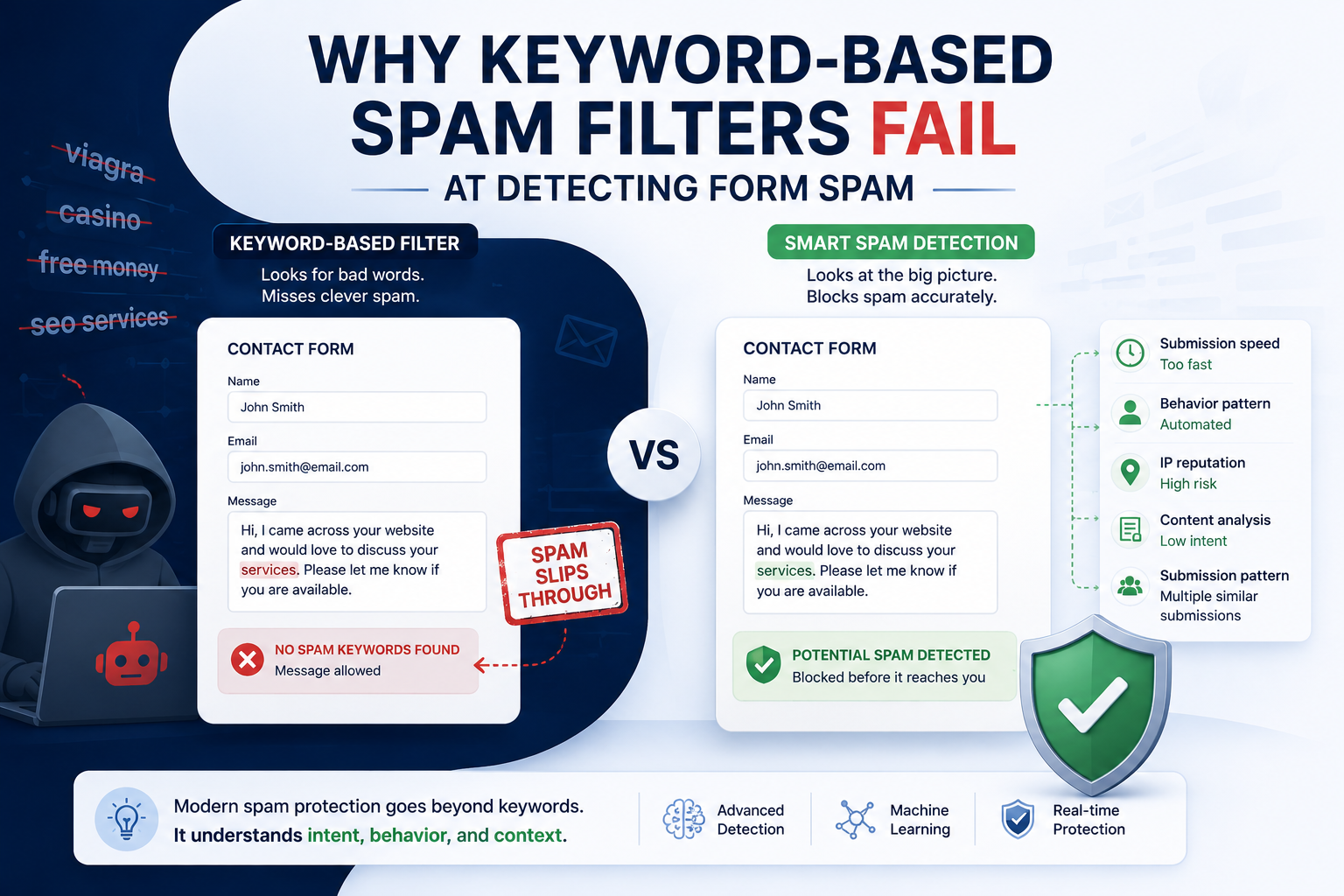
SpamForms is designed to help businesses manage contact form spam by analysing the intent and context of submitted messages.
Rather than relying exclusively on CAPTCHA or static blocklists, it helps identify likely spam and separate unwanted submissions from genuine enquiries.
This gives businesses a more considered way to manage form submissions, with suspicious messages held for review rather than automatically disappearing without a trace.
The aim is straightforward:
Reduce the time spent sorting irrelevant submissions.
Help genuine enquiries reach the appropriate destination.
Keep suspicious messages available for review.
Support a cleaner process for managing website leads.
No filtering system is perfect, and businesses should continue monitoring classification quality and checking that legitimate enquiries are handled correctly.
SpamForms isn't a substitute for good analytics, relevant traffic, or a well-designed sales process. It's one part of the bigger picture: making the journey from website visitor to genuine enquiry more manageable.
Discover how SpamForms works and see how message-aware filtering can help your business handle unwanted form submissions.
9. A Quick Website Lead-Quality Audit
Before you change your marketing strategy, spend 30 minutes reviewing what your website is actually delivering.
Step 1: Check your conversion tracking.
Confirm that your form conversion event represents a successful submission rather than just a button click.
Step 2: Review a sample of recent submissions.
Classify messages as genuine enquiries, irrelevant messages, spam, or uncertain. Avoid assuming that every unusual message is automatically spam.
Step 3: Compare raw and genuine submissions.
Calculate how many submissions remain after reviewing their quality. Compare the results across weeks or months when you have enough consistent data.
Step 4: Check your response process.
Are genuine enquiries reaching the right person? Are messages being delayed because the team has to sort through irrelevant submissions?
Step 5: Review your form protection.
Check your existing anti-spam measures, including any CAPTCHA, honeypot, rate-limiting, or message-filtering tools. Make sure legitimate visitors can still submit enquiries easily.
Step 6: Connect leads to outcomes.
Where practical, track which enquiries become qualified opportunities and customers. This helps you evaluate the business value of your traffic rather than relying on submission volume alone.
Repeat the audit periodically. A single review gives you a snapshot; consistent measurement helps you identify trends.
The Bottom Line: Traffic Is the Beginning, Not the Finish Line
More traffic can create more opportunities, but it doesn't guarantee more customers.
Your website needs relevant visitors, clear messaging, a straightforward conversion process, reliable tracking, and a way to manage the messages that arrive.
When contact form spam gets mixed into your enquiries, it can add unnecessary work and make raw conversion numbers harder to interpret.
The solution isn't to obsess over every suspicious submission or abandon your traffic strategy.
It's to understand what your metrics mean, protect the enquiry process, and measure the outcomes that matter.
Because a website shouldn't be judged solely by how many people visit or how many times someone clicks Submit.
It should also be judged by how effectively it helps the right people start meaningful conversations with your business.
Your traffic tells you who's arriving. Your lead-quality process helps you understand who's actually interested.
Ready to spend less time sorting unwanted submissions and more time focusing on genuine opportunities?
Explore SpamForms and take a smarter approach to contact form spam protection.