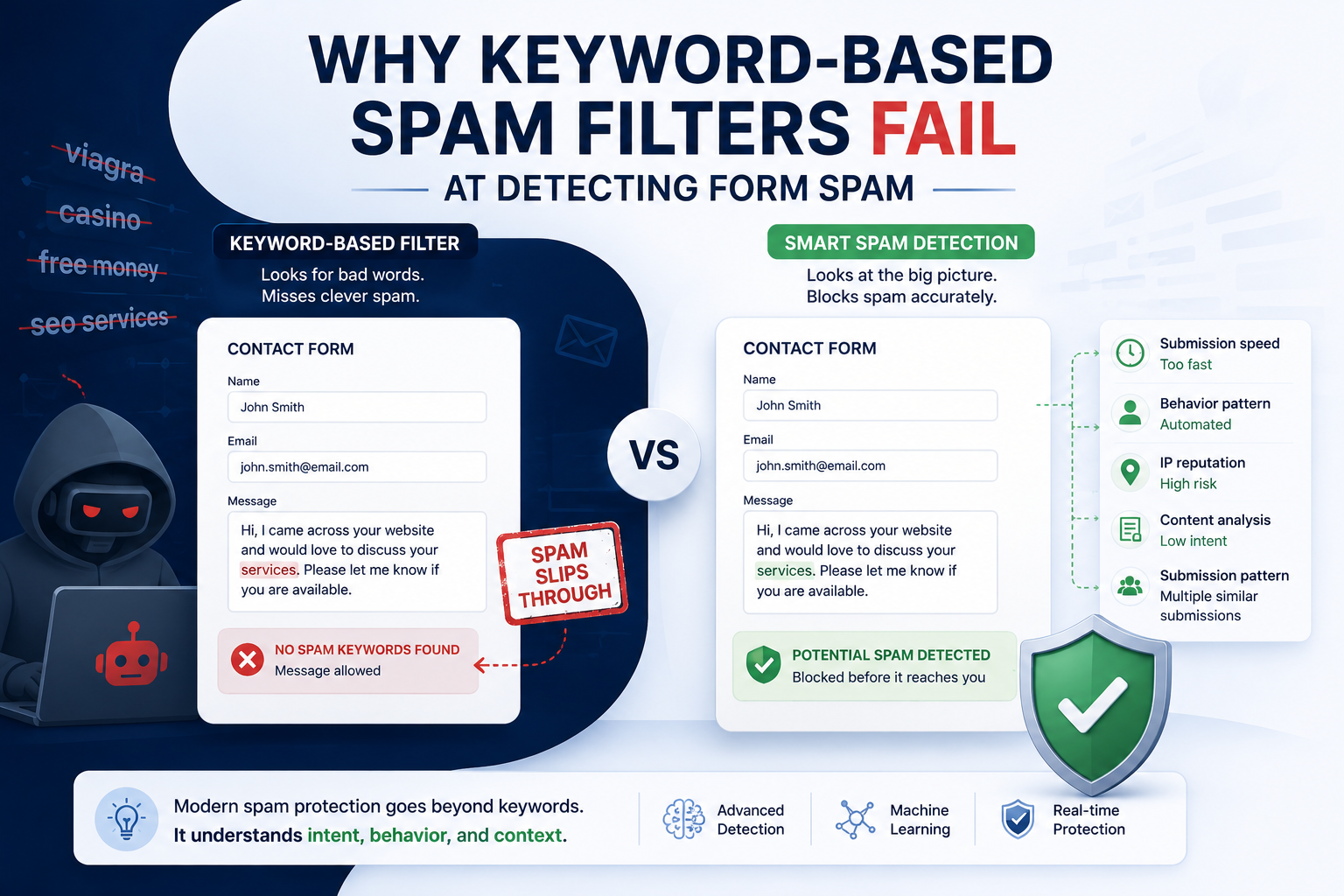
For years, spam filtering has relied on a simple idea:
Find the bad words and block the message.
It sounds logical.
If a message contains certain phrases, suspicious links, or known spam patterns, the filter can reject it.
The problem?
Spammers know this too.
Modern spam doesn't always look like spam anymore.
The Problem With "Bad Words"
Imagine your contact form receives this message:
"Hi, I came across your website and would love to discuss your services. Please let me know if you are available for a quick conversation."
Nothing obviously looks wrong.
There are no suspicious words.
No obvious sales pitch.
No strange formatting.
Yet the message could still be completely automated.
A keyword-based filter has very little to work with.
Now imagine the spammer changes the wording slightly for every submission.
The same campaign can produce hundreds of different messages without using the same obvious keywords.
Spammers Can Simply Change the Words
This creates a constant game of catch-up.
A filter blocks:
"We can improve your Google rankings."
The spammer changes it to:
"Our team can help increase your organic visibility."
The filter blocks that.
The spammer changes it again.
The meaning stays the same.
The words change.
This is one of the biggest weaknesses of relying too heavily on keyword-based spam detection.
Words can change much faster than intent.
Context Is More Interesting Than Keywords
Instead of asking:
"Does this message contain a spam word?"
A smarter system can ask:
"Does this submission actually look like a genuine enquiry?"
That's a much more useful question.
For example, someone contacting a web development company might write:
"We're looking to rebuild our website and would like to discuss your development services."
The words "website" and "services" could appear in both genuine enquiries and spam.
The difference is the context.
A good spam filter needs to understand more than individual words.
Behaviour Tells Another Story
The message itself is only one part of the picture.
How the form was submitted can provide additional signals.
For example:
- How quickly was the form completed?
- Was the interaction consistent with a normal visitor?
- Were multiple submissions made in a short period?
- Does the same pattern appear across other submissions?
- Does the submission look automated?
Modern bot protection increasingly uses multiple detection signals and machine-learning models rather than relying on a single rule.
That matters because a genuine customer and an automated bot can write very similar messages—but their behaviour may be very different.
One Signal Isn't Enough
This is where spam detection gets interesting.
A fast submission doesn't automatically mean spam.
A message containing a link doesn't automatically mean spam.
A short message doesn't automatically mean spam.
Even an unusual IP address doesn't automatically mean the person is malicious.
Each signal needs context.
Modern detection works better when multiple indicators are considered together rather than allowing one rule to make the entire decision. Layered bot-detection systems already use this approach, combining different detection engines and signals to assess automated traffic.
Why This Matters for Your Contact Form
Your contact form has two jobs:
Make it easy for real customers to contact you.
Keep unwanted submissions away from your inbox.
If your spam filter relies on aggressive keyword rules, you may end up blocking messages simply because they contain something that looks suspicious.
That's where false positives become a problem.
And if you make the rules too loose, more spam gets through.
You end up choosing between:
Block more → risk losing real enquiries.
Block less → deal with more spam.
There is a better approach.
Don't Ask "Is This Spam?" Too Early
Instead of making a decision based on one suspicious word, modern spam detection can look at the bigger picture.
Think of it like this:
Message + Behaviour + Timing + Patterns + Context
Together, these signals can provide a much clearer picture of a submission than keywords alone.
The goal isn't to find a magic word that identifies spam.
The goal is to understand whether the submission actually looks like a genuine enquiry.
The Future of Form Spam Detection
Spam is becoming more sophisticated.
Automated tools can generate more natural messages, change their wording, and vary their behaviour.
That means spam protection needs to evolve too.
The future isn't simply:
"Block messages containing these words."
It's closer to:
"Understand the submission before deciding what to do with it."
And importantly, this can happen without forcing every visitor to complete a CAPTCHA or additional challenge. Even Google's reCAPTCHA v3 and modern bot-management platforms have moved toward risk scoring and invisible signals rather than always presenting an interactive puzzle.
How SpamForms Takes a Smarter Approach
SpamForms is built around the idea that effective form protection should look beyond obvious spam keywords.
By considering the submission itself and the signals surrounding it, SpamForms helps identify unwanted form spam while keeping the experience simple for genuine customers.
Because the best contact form protection isn't necessarily the one that blocks the most messages.
It's the one that blocks the right messages.
Want to see what's happening behind the scenes?