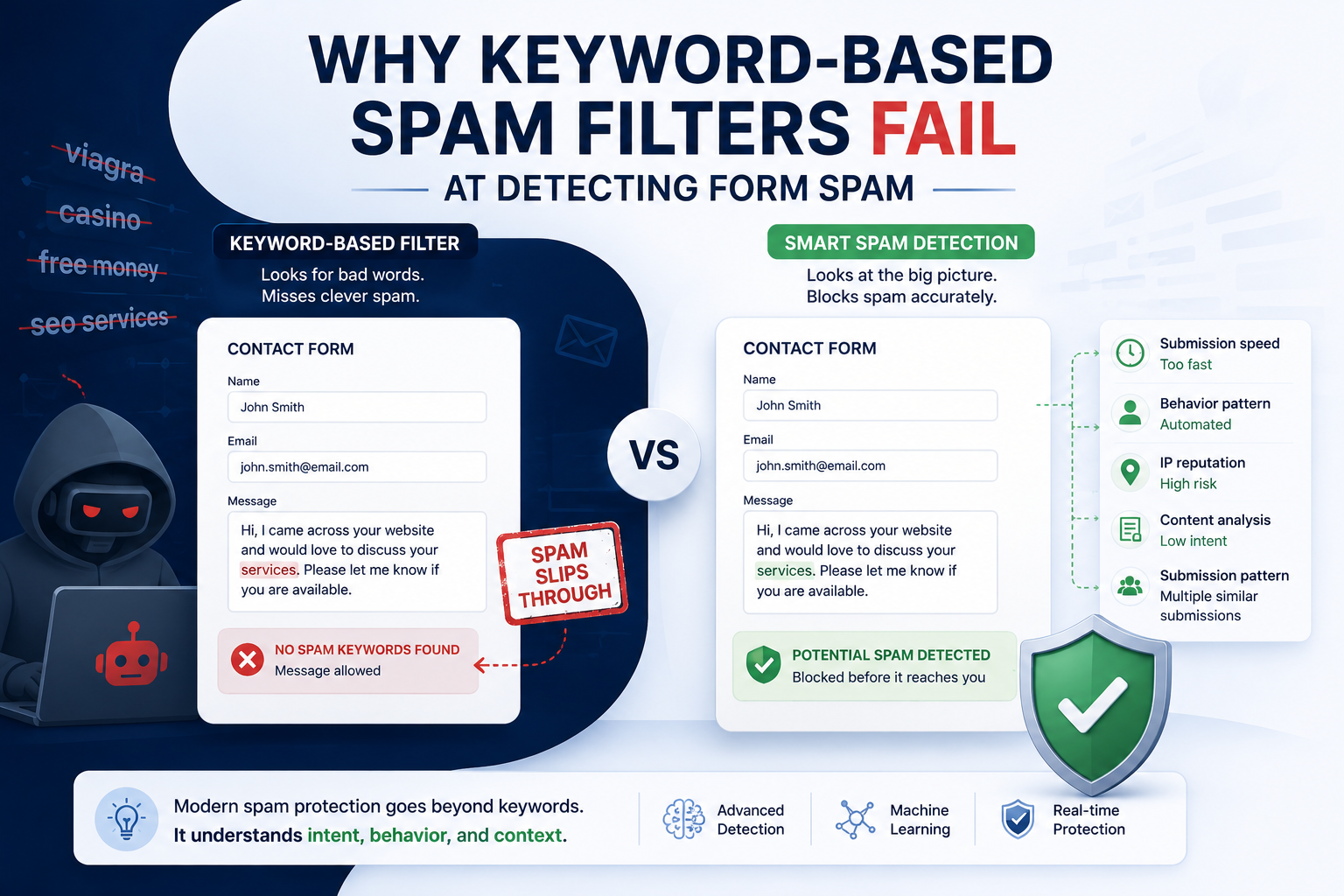
Traditional spam filters work from lists: block these words, these addresses, these links. That worked when spam was repetitive. Today, a single template can be rewritten a thousand ways, and blocklists are always one step behind.
Reading, Not Matching
AI filtering takes a different approach. Instead of matching keywords, it reads the submission the way a person would and asks a simple question: does this look like a real enquiry for this business?
This is the approach behind AI-powered spam filtering, which looks at the meaning, context, and intent of a submission rather than relying only on fixed lists and keyword rules.
Context
It knows what your business does, so a message about a service you do not offer, sent from a mismatched location, stands out.
Intent
It can tell the difference between:
“I would like a quote for your services.”
and:
“I can help you rank #1 on Google.”
Both may contain perfectly normal words. But only one is likely to be a genuine enquiry.
Consistency
It notices when the same shape of message arrives across many businesses at once, even when the wording has been changed.
What Happens to a Submission?
Every submission is read and classified.
Genuine leads are forwarded to you — parsed into a clean, consistent format that is easy to reply to.
Spam is held back. Nothing is deleted, so you can always look at what was filtered and why, and pull anything back if you disagree.
This means your website forms can stay open to genuine enquiries without forcing you to manually sort through every submission.
Why It Keeps Working
Because the filter understands meaning rather than memorising patterns, it adapts as spam evolves.
New tactics that would slip past a blocklist still have to look like a believable enquiry — and that is a much harder bar for a spammer to clear.
The result is a more intelligent approach to protecting website forms: not simply asking whether a message contains a suspicious word, but whether the submission actually makes sense in the context of the business receiving it.