You build a website.
You add a contact form.
Then, somehow, a stranger or more accurately, a bot finds it and starts sending messages about SEO services, crypto, software, backlinks, or something completely unrelated to your business.
So why does this happen?
Why do bots target contact forms in the first place?
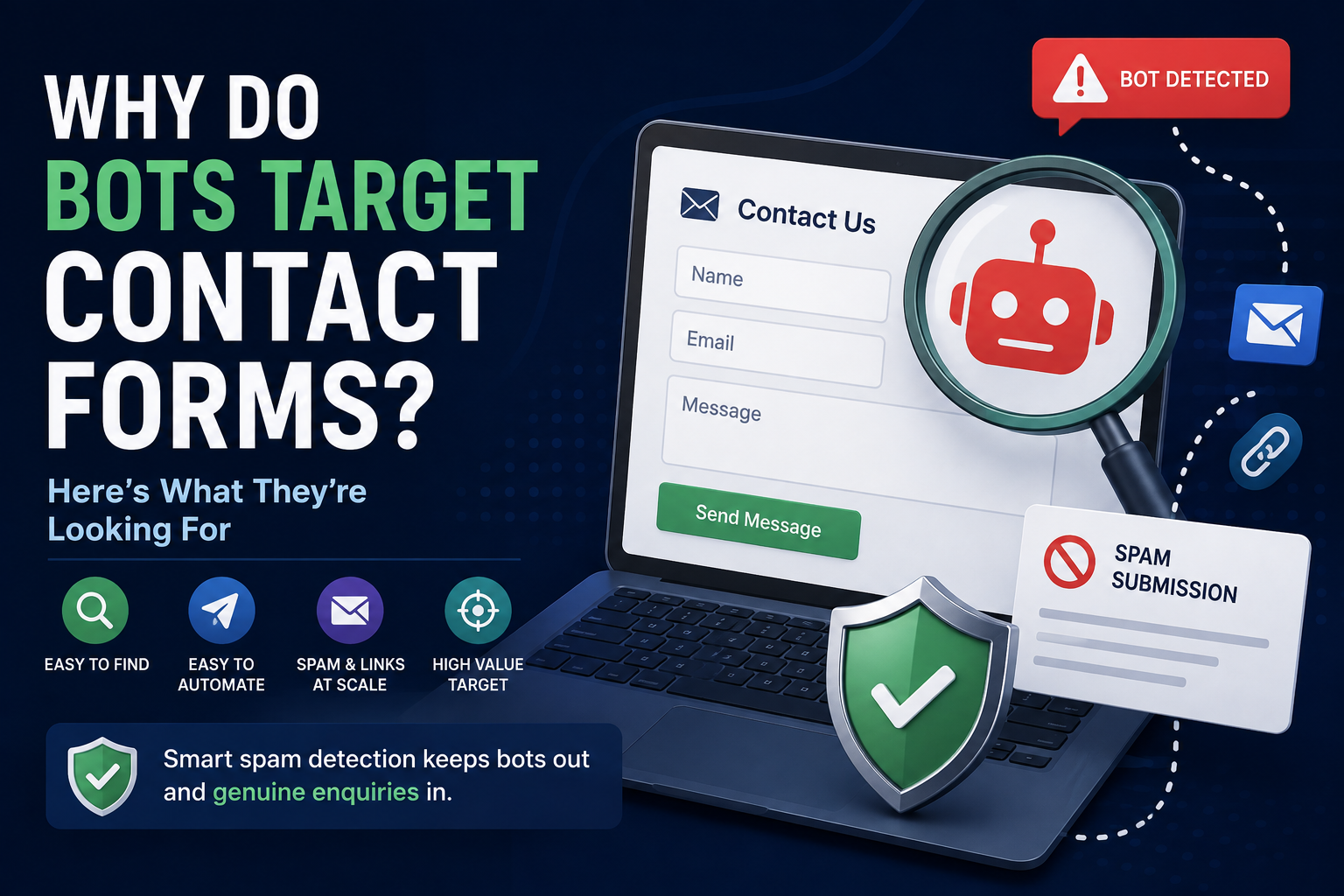
The answer is surprisingly simple: contact forms are easy to find, easy to automate, and potentially valuable to whoever is sending the spam.
Your Contact Form Is an Open Door
A contact form is designed to make communication easy.
For a genuine customer, that's exactly what you want.
But from a bot's perspective, a publicly accessible form is also an opportunity.
Automated software can search websites for common form structures, identify input fields, and attempt to submit information without anyone sitting behind a keyboard.
The bot doesn't care whether your business is a restaurant, an accountant, a software company, or a plumber.
If it finds a form, it may try it.
What Are Bots Actually Looking For?
Not every bot is trying to steal information.
Many are simply looking for opportunities to send messages at scale.
Common goals include:
Selling Something
A large amount of contact form spam is simply automated sales outreach.
The bot may submit:
- SEO offers
- Web design services
- Marketing services
- AI tools
- Software products
- Link-building services
Instead of sending one salesperson to contact 500 businesses, automation can submit messages to 500 websites in a fraction of the time.
Spreading Links
Some bots are interested in getting links into messages.
The content may contain URLs pointing to websites, products, or other destinations.
Even when the message looks harmless, the objective is often the same: distribute links at scale.
Testing Vulnerable Forms
Some automated activity is more concerning.
Bots may test whether a form accepts unexpected input, whether submissions are properly validated, or whether the website behaves differently when unusual data is submitted.
This is one reason contact form security should be treated as more than simply an inbox-cleaning problem.
Building Spam Campaigns
A bot doesn't necessarily need to know anything about your business.
It can collect thousands of websites first and decide what to send later.
This makes the process highly scalable.
The bot finds the forms.
Automation handles the submissions.
Someone else deals with the mess.
How Do Bots Find Contact Forms?
This is where things get interesting.
Bots don't necessarily need to know your website personally.
They can discover forms automatically while crawling websites.
They may look for familiar elements such as:
- Contact pages
- Form fields
- Submit buttons
- Common HTML structures
- Recognisable form plugins
- Standard URLs and page patterns
Once a form is identified, an automated system can attempt to interact with it.
This is why simply hiding your contact page or changing the wording of your button rarely solves the problem.
The problem is not necessarily that someone knows your business.
The problem is that your form is publicly accessible.
And that's exactly what it was designed to be.
Why Bots Can Submit Forms So Quickly
Imagine a real customer filling out your form.
They read the page.
They think about what they want to say.
They type their name.
They enter their email.
They write a message.
Then they submit.
A bot doesn't need to do any of that.
It can send data directly and repeat the process thousands of times.
That's why you might receive several suspicious submissions within seconds or see the same message appearing across multiple forms.
The speed itself can become an important signal.
The Problem With Trying to "Outsmart" Every Bot
A common reaction is to add more barriers.
First, add CAPTCHA.
Then block an IP address.
Then block a keyword.
Then block another country.
Then add another rule.
Eventually, the form becomes harder for legitimate customers to use while determined bots continue adapting.
The problem is that you're fighting the bot at the wrong level.
Instead of asking:
"How can I make my form harder to submit?"
A better question is:
"How can I understand which submissions are worth keeping?"
That is a very different approach.
Humans and Bots Leave Different Signals
A genuine customer and an automated script may both submit the same form.
But the way they arrive there can be very different.
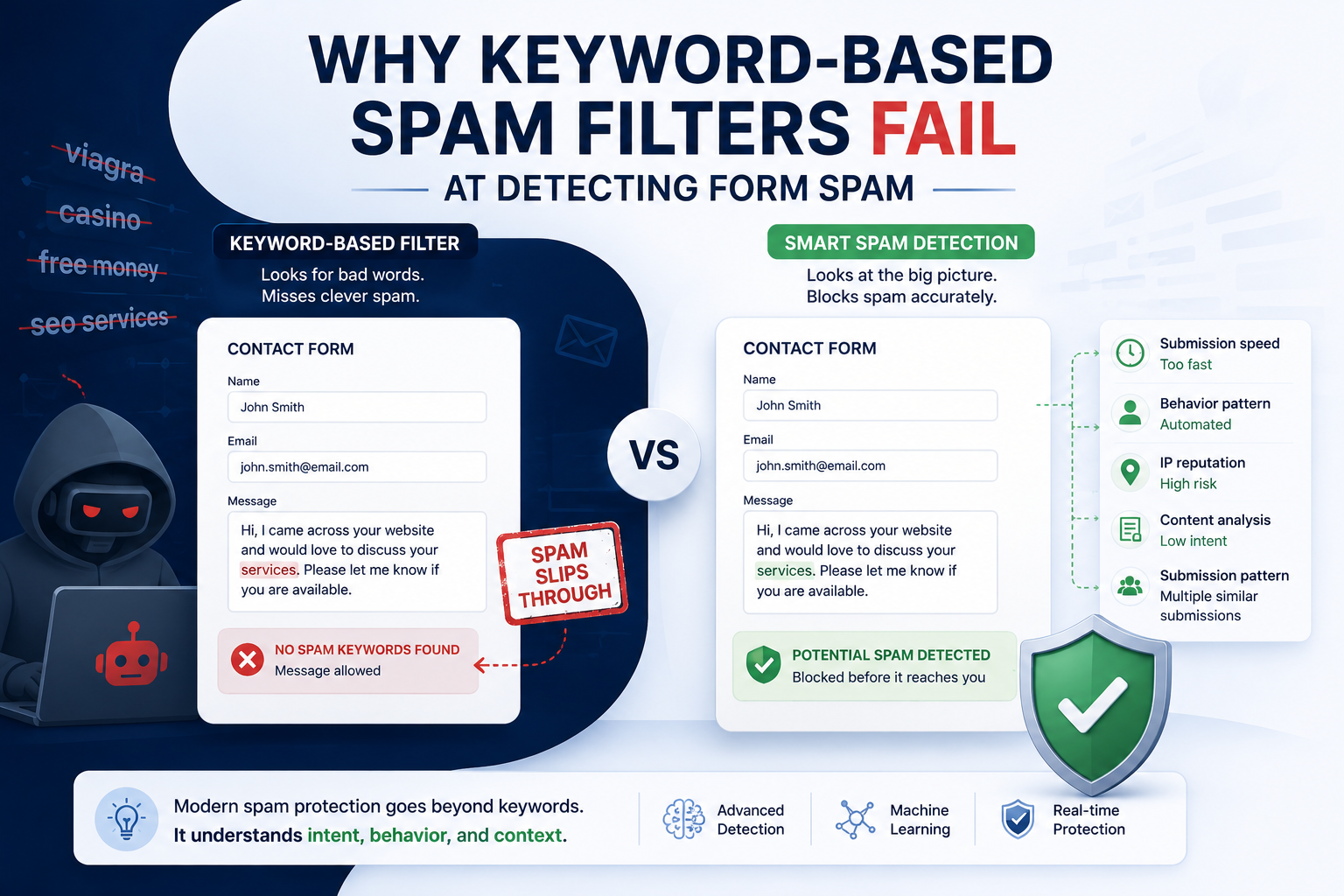
A spam detection system can consider signals such as:
- Submission timing
- Interaction behaviour
- Repeated patterns
- Message content
- Links
- Previous activity
- The context of the submission
None of these signals is perfect by itself.
A fast submission isn't automatically spam.
A message containing a link isn't automatically spam.
And a new visitor isn't automatically suspicious.
The interesting part is what happens when multiple signals are considered together.
This Is Why CAPTCHA Isn't the Whole Answer
CAPTCHA tries to answer one question:
"Are you human?"
But that isn't always the question a business actually needs answered.
What you really want to know is:
"Is this a genuine enquiry?"
A real person can send an unwanted sales pitch.
A bot can generate a message that looks remarkably human.
So human-versus-bot isn't always enough.
The goal is to understand the submission itself.
That's where modern spam detection becomes more interesting.
Stop Fighting Bots at the Front Door
Your contact form should remain easy for genuine customers to use.
You shouldn't have to turn every visitor into a security test just because bots exist.
Instead, protection can happen quietly in the background.
SpamForms analyses contact form submissions using multiple signals to help identify unwanted activity while keeping the experience simple for genuine visitors.
Want to see what happens behind the scenes?
Learn how SpamForms works to see how behaviour, content, and other signals can be used to identify contact form spam.
The Real Goal
Bots will continue to find public contact forms.
They will change their messages.
They will change their behaviour.
And they will keep looking for ways to automate the process.
The goal isn't to make your contact form impossible for bots to access.
The goal is to make their submissions irrelevant to you.
Let the form stay open.
Let genuine customers contact you.
And let the spam detection happen quietly in the background.