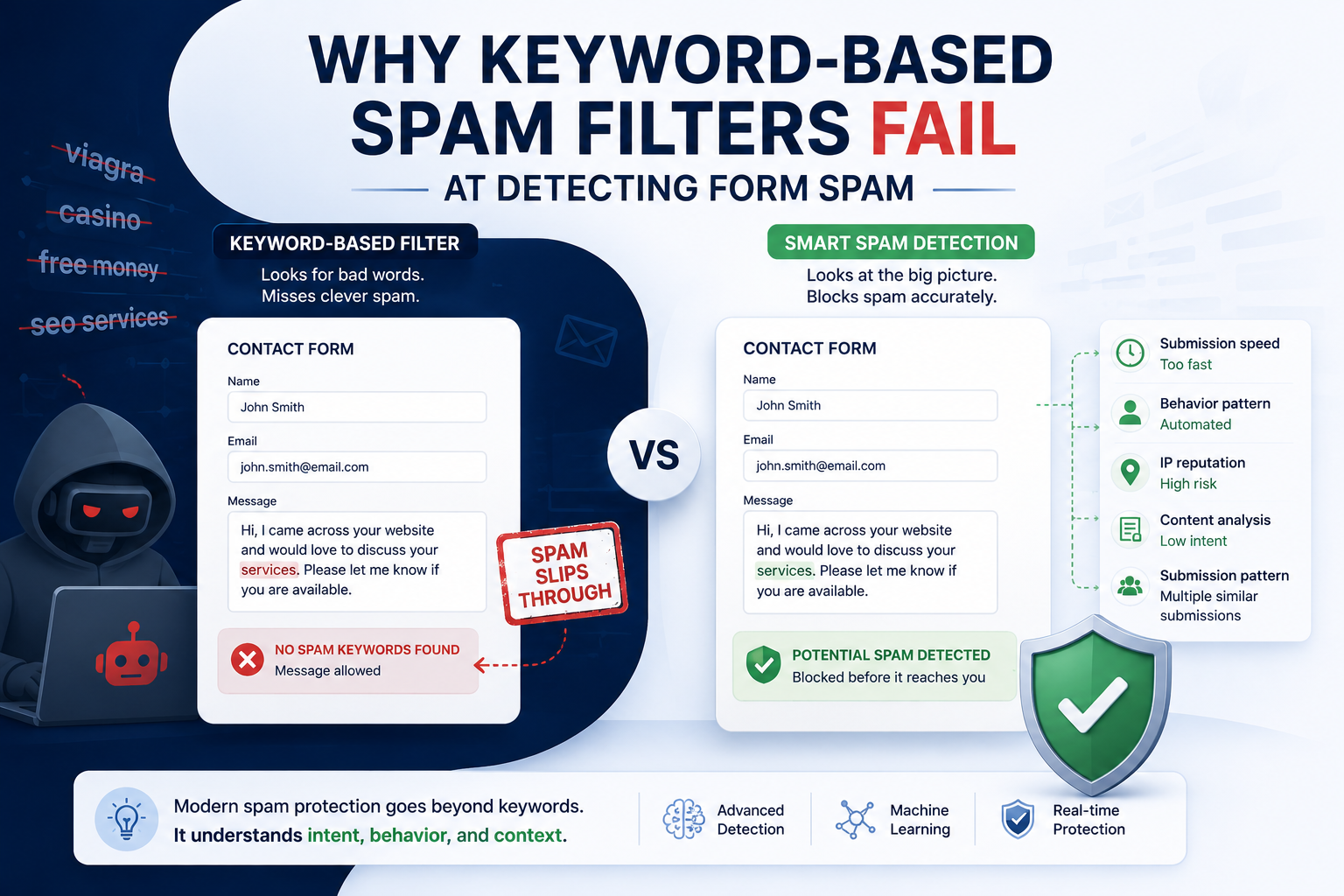
Imagine losing a customer without ever knowing they contacted you.
No angry phone call. No negative review. No message saying they went with a competitor.
They simply sent an enquiry, waited for a response, and moved on.
Now imagine that their message arrived right between a backlink pitch, an irrelevant agency offer, and a suspicious submission advertising something your business has absolutely no interest in.
The enquiry was there.
Your inbox received it.
But did anyone notice?
Welcome to one of the most overlooked problems in online lead generation: when too much spam makes it harder to recognise the messages that matter.
1. The Boy Who Cried Wolf, but Make It Email
Remember the story of the boy who repeatedly cried wolf until nobody believed him?
Your inbox can develop a similar problem.
Every day, it delivers notifications. Some are important. Some are routine. Others are completely irrelevant.
Now add a steady stream of contact form spam.
At first, you inspect every message carefully. You delete the obvious junk and get on with your day.
A week later, you're recognising familiar spam patterns.
A month later, you're scanning subject lines and dismissing anything that looks remotely suspicious.
Eventually, opening a new enquiry feels less like discovering an opportunity and more like checking another chore off your list.
This is a form of alert fatigue: when repeated, low-value notifications make it harder to give important ones the attention they deserve.
The problem isn't necessarily that your inbox cannot receive genuine leads.
It's that the signal is getting buried in the noise.
2. Spam Doesn't Need to Hack Your Website to Hurt Your Business
When people hear the word cybersecurity, they often imagine stolen passwords, malicious software, or a website that suddenly stops working.
Those are serious concerns, but not every business problem needs a dramatic cyberattack.
Sometimes, the damage is much less spectacular.
Your contact form keeps working. Your emails keep arriving. Your website remains online.
Everything looks fine.
Meanwhile, your team spends time sorting irrelevant enquiries, sales staff become less enthusiastic about checking submissions, and useful conversations may take longer to reach the right person.
Spam can create operational friction without taking your website offline.
And because the website still appears to function normally, the problem can go unnoticed.
A working contact form is not necessarily an effective lead-generation system.
The quality of what happens after submission matters just as much as the submission itself.
3. The Most Expensive Message Might Be the One You Ignore
Let's make this practical.
Imagine a digital agency receives 40 contact form submissions in a week.
Some are genuine enquiries. Others are sales pitches, irrelevant offers, or automated spam.
The team cannot instantly tell which messages deserve attention, so someone reviews them manually.
Now imagine a potential customer submits this:
"Hi, we're looking for a development partner to rebuild our ecommerce website. Could you send through some information about your process and pricing?"
It is a perfectly ordinary enquiry.
But if the team has spent the morning deleting junk, that message may not receive the attention it deserves straight away.
We cannot assume every spam message causes a lost sale. Nor can we know how many genuine enquiries are missed without examining the actual data.
But the business risk is clear: when every submission demands attention, identifying the valuable ones becomes harder.
That is why lead quality should be part of your website strategy, not just a concern for your sales team.
4. Why "Just Hire Someone to Check the Inbox" Isn't the Whole Answer
Manual review has its place. Human judgement is valuable, especially when a message is unusual or ambiguous.
But using people as the only line of defence creates another problem.
Their time is limited.
Every minute spent reviewing an irrelevant submission is a minute they cannot spend following up a prospect, preparing a proposal, improving a campaign, or helping an existing customer.
And the workload grows with the volume of submissions.
You could ask someone to check the inbox more frequently. You could create more filters. You could build a longer list of blocked words.
Each approach might help in certain circumstances.
But none automatically solves the underlying challenge: distinguishing unwanted messages from relevant enquiries.
The goal should not be to make your team better at handling an endless stream of junk.
It should be to reduce how much unnecessary noise reaches them in the first place.
5. CAPTCHA Can Stop Some Bots. It Can't Judge Every Sales Pitch.
CAPTCHA can help protect forms against certain automated submissions. Rate limiting, honeypot fields, and other anti-spam measures can also play useful roles.
But consider this message:
"Hello, we help businesses increase their organic traffic with high-quality backlinks. Would you be interested in discussing our services?"
A human could write it. A bot could submit it. Either way, the message might be irrelevant to the business receiving it.
Passing a human-verification challenge does not automatically make a submission valuable.
Likewise, a message containing a link isn't automatically spam. A genuine customer might include their website, a reference page, or a link to a project brief.
This is why relying on one signal alone can be limiting.
Effective form protection benefits from looking at the wider context, while recognising that no automated system can classify every message perfectly.
6. Give Every Submission a Job
Here's a better way to think about your contact form.
Instead of treating it as a digital mailbox, treat it as the beginning of a sorting process.
A useful workflow might look like this:
Submission received → Message assessed → Appropriate action taken
For example:
- Likely genuine enquiry: Forward it to the right person or sales inbox.
- Likely spam: Separate it from normal enquiries for appropriate handling.
- Uncertain message: Flag it for human review rather than assuming the system is always right.
This approach helps separate the act of collecting messages from the job of evaluating them.
It also makes your process easier to improve over time. You can review misclassified submissions, adjust your rules, and identify the kinds of unwanted messages your business receives most often.
The objective isn't to eliminate every suspicious message at any cost.
It's to help genuine enquiries receive attention without creating unnecessary barriers for legitimate visitors.
7. Your Website Traffic Is Only Half the Story
Businesses invest heavily in attracting visitors.
They publish SEO content, run paid advertising, improve landing pages, and experiment with calls to action.
Then they measure form submissions.
But what does that number actually tell you?
A hundred submissions might sound impressive. Yet if a substantial portion consists of irrelevant messages, the headline number can paint an incomplete picture of performance.
Consider two hypothetical websites:
Website A
- 100 form submissions
- 25 genuine enquiries
Website B
- 60 form submissions
- 35 genuine enquiries
Website B generates fewer total submissions but more genuine enquiries in this example.
That doesn't mean fewer submissions are always better. The figures are illustrative, not industry benchmarks.
It means businesses should look beyond raw submission volume.
Useful metrics include genuine enquiry volume, spam rate, response time, qualified lead rate, and the percentage of enquiries that progress to a meaningful sales conversation.
When you understand the quality of your submissions, you can make better decisions about your website and marketing.
8. Meet SpamForms: Less Noise, More Context
This is where SpamForms comes in.
SpamForms is designed to help businesses manage contact form spam by analysing the intent and context of submitted messages.
Rather than relying exclusively on CAPTCHA or static blocklists, it helps distinguish likely unwanted submissions from genuine enquiries.
The aim is straightforward:
- Help genuine enquiries reach the right destination.
- Identify likely spam so it can be handled separately.
- Keep suspicious messages available for review rather than treating every uncertain submission as something to delete.
- Reduce the manual effort associated with sorting irrelevant form submissions.
Of course, spam detection isn't infallible. Businesses should still have an appropriate review process and check that genuine enquiries are being handled correctly.
But your team shouldn't have to approach every new submission as an investigation.
Your contact form should help you discover opportunities, not bury them.
Learn more about how SpamForms works.
9. A Simple Inbox Audit You Can Do This Week
Want to know whether this problem affects your business?
Start with a small review.
Step 1: Sample recent submissions.
Review a representative batch of recent contact form messages. Separate genuine enquiries, irrelevant pitches, obvious spam, and uncertain cases.
Step 2: Calculate your spam rate.
Divide the number of submissions classified as spam by the total number reviewed, then multiply by 100.
For example, if 30 out of 100 reviewed submissions are spam, your sample spam rate is 30%.
Remember that this is a sample, not necessarily your long-term rate.
Step 3: Check response times.
Look at how quickly genuine enquiries receive their first response. Compare periods with heavier spam volumes if reliable records are available.
Step 4: Look for patterns.
Are you receiving repeated backlink pitches, irrelevant service offers, suspicious URLs, or bursts of similar submissions?
Identifying patterns can help you choose suitable protection measures.
Step 5: Review your safeguards.
Check whether your forms use appropriate anti-spam measures and whether suspicious messages are separated from genuine enquiries. Make sure legitimate visitors can still submit their forms easily.
Step 6: Measure what improves.
After making changes, compare spam volume, genuine enquiry volume, response times, and false positives.
The goal is not merely a cleaner inbox. It is a more reliable path from website visitor to genuine business conversation.
Stop Letting the Noise Set the Agenda
Spam doesn't always arrive with flashing warning signs.
Sometimes it looks like an ordinary enquiry. Sometimes it is obviously irrelevant. And sometimes the biggest problem is the cumulative effect of seeing too much junk, too often.
Over time, a cluttered inbox can make important messages harder to recognise and unnecessary work harder to avoid.
Your team deserves better than a daily guessing game.
Your genuine prospects deserve better than being mixed into an endless queue of irrelevant submissions.
And your website deserves a lead-management process that looks beyond the number of times someone clicks Submit.
Keep the door open for genuine customers. Give unwanted messages less room to distract your team.
Explore SpamForms and discover a more considered approach to contact form spam protection.
Because the next important enquiry shouldn't have to shout just to be heard.