Imagine this.
A potential customer visits your website. They've found exactly the service they're looking for, they've read your content, and they're finally ready to get in touch.
They fill out your contact form.
They explain what they need, include their website address, and submit their enquiry.
Everything appears to work.
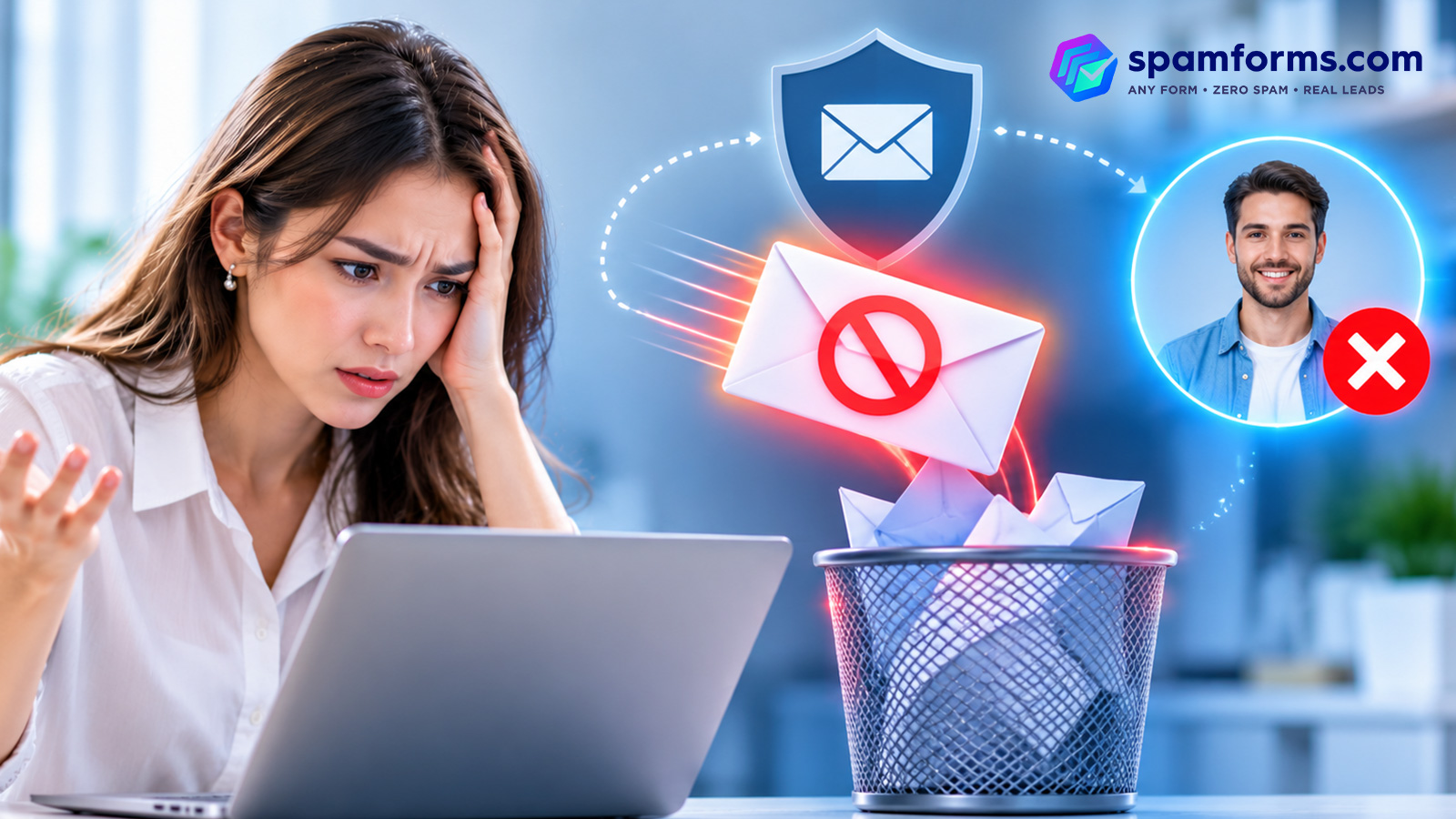
Except their message never reaches your inbox.
No notification. No conversation. No opportunity to follow up.
Why?
Because your spam filter decided the message looked suspicious.
Welcome to one of the most overlooked challenges in website form security: false positives.
Most businesses focus on stopping spam. Far fewer consider what happens when their protection system mistakenly blocks the very people they're trying to attract.
And that mistake can be more expensive than it initially appears.
1. What Exactly Is a False Positive?
In spam filtering, a false positive happens when a legitimate message is incorrectly classified as spam.
In other words, the system identifies a genuine submission as unwanted and handles it accordingly.
This is different from a false negative, where actual spam passes through a filter and is incorrectly treated as legitimate.
Both are problems, but they create different risks.
Consider the following examples:
Scenario A: A false positive
A customer submits a genuine enquiry containing a website URL and several technical terms. The spam filter interprets the content as suspicious and blocks or quarantines the message.
Scenario B: A false negative
Someone submits an unsolicited backlink offer using a normal-looking name and email address. The filtering system fails to recognise the message as spam, allowing it into the business inbox.
The challenge is finding the right balance.
A filtering system that allows everything creates unnecessary noise.
A system that blocks too aggressively can prevent legitimate customers from reaching your business.
Effective spam protection isn't simply about blocking more. It's about making better decisions.
2. Why Genuine Messages Sometimes Look Like Spam
Here's where things get interesting.
A genuine customer doesn't necessarily write messages that look clean, predictable, or professionally structured.
People communicate differently.
Some write short messages. Others provide extensive details. Some include links, attachments, technical terminology, or unusual formatting.
Unfortunately, these characteristics can sometimes overlap with patterns commonly associated with spam.
Here are several situations where legitimate submissions may trigger spam detection.
Unusual wording
A customer might use unfamiliar industry terminology, abbreviations, or phrases that appear frequently in unwanted promotional messages.
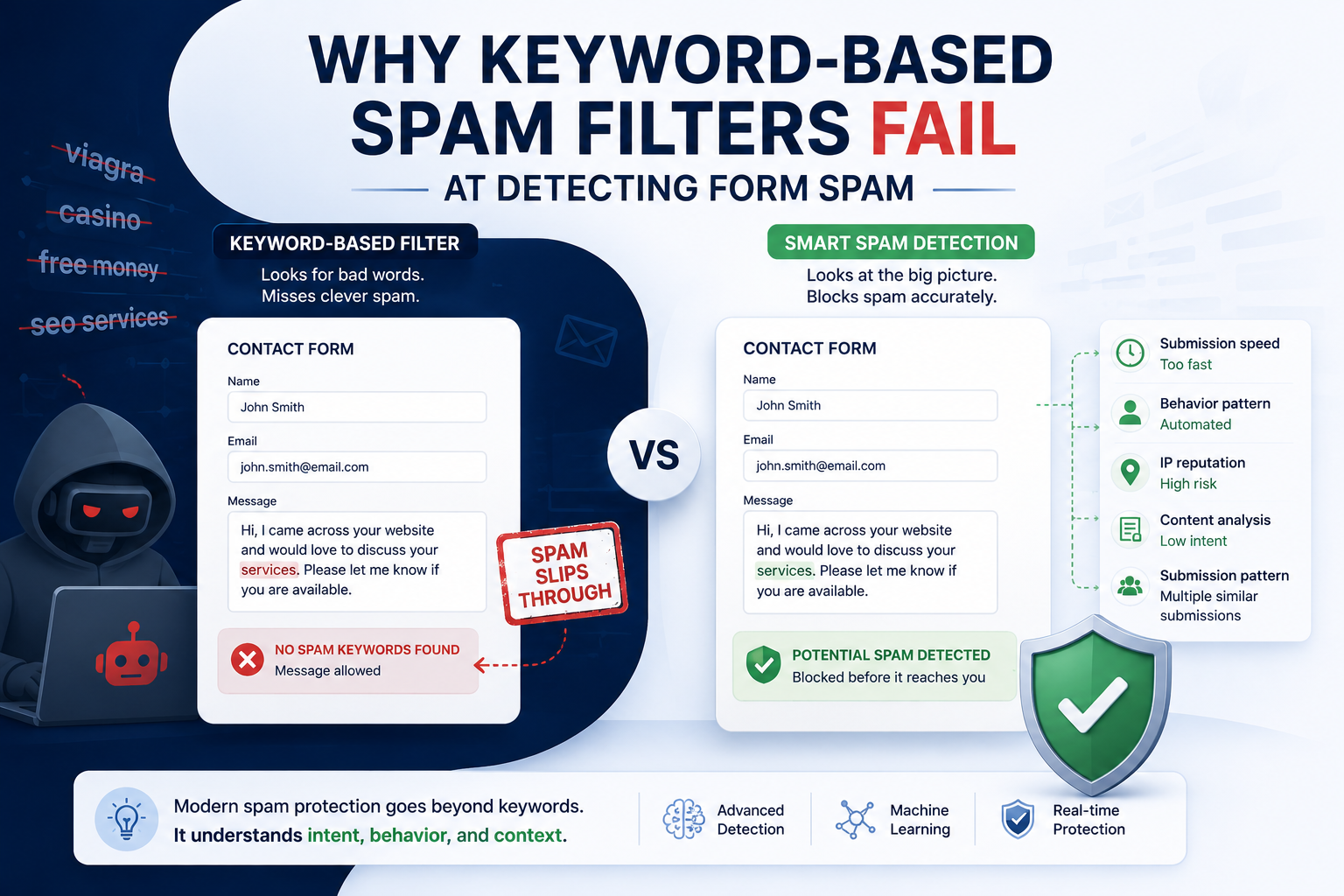
A basic keyword-based filter might interpret those similarities incorrectly.
Website URLs
Someone requesting website development, SEO services, or digital marketing assistance may naturally include their existing website address.
However, links are also frequently found in spam submissions.
Simply including a URL shouldn't automatically make a message suspicious.
Multiple submissions
A visitor might submit a form more than once because they didn't receive a confirmation email or weren't sure whether their first submission worked.
Repeated submissions can sometimes trigger duplicate detection or rate-limiting rules.
International enquiries
Businesses serving international markets may receive messages from unfamiliar regions, domains, or email providers.
A filtering system that relies too heavily on geographic or domain-based assumptions could create unnecessary restrictions.
Poorly written messages
Not every genuine customer writes perfect English.
Grammar mistakes, unusual sentence structures, and short descriptions shouldn't automatically be treated as evidence of spam.
The important lesson is that individual signals need context.
Something that looks suspicious in isolation may make perfect sense when the entire message is considered.
3. The Hidden Business Cost of Over-Filtering
Most companies understand the inconvenience of spam.
Fewer calculate the potential cost of blocking legitimate enquiries.
Let's look at a hypothetical example.
A business receives 200 contact form submissions every month.
After reviewing them, it discovers that 150 are genuine enquiries and 50 are unwanted messages.
Now imagine its filtering system incorrectly blocks 5% of the genuine enquiries.
That's approximately 7 or 8 potential customers who may never reach the business.
What could that mean financially?
Suppose the business converts 20% of its genuine enquiries into customers, with an average customer value of $1,000.
Seven missed enquiries could represent an expected $1,400 in potential sales value.
These figures are illustrative, not industry benchmarks or guaranteed lost revenue. Actual outcomes depend on conversion rates, customer value, and whether those enquiries would have become sales.
But the principle is important.
A filtering system can appear highly effective because it blocks a large amount of spam while quietly creating another problem.
The cost of spam protection should never be measured only by how much spam it stops.
It should also consider what legitimate communication it allows through.
4. The Problem With Relying on Static Blocklists
Blocklists are a common component of spam prevention.
They can be useful for identifying known unwanted email addresses, domains, IP addresses, or other indicators.
However, they have limitations.
Spammers can change their email addresses, domains, infrastructure, and message content.
At the same time, legitimate users may share characteristics with previously identified spam sources.
For example, blocking an entire email domain because of a suspicious submission could potentially affect other legitimate users who happen to use the same provider.
A blocklist can tell you that something has been associated with unwanted activity.
It doesn't necessarily explain the intent behind a new message.
That's why blocklists are generally more effective as one layer of protection rather than the entire filtering strategy.
5. CAPTCHA Solves a Different Problem
CAPTCHA is useful for reducing certain automated submissions.
It can introduce an additional challenge designed to distinguish human interactions from automated activity.
But CAPTCHA doesn't determine whether a message represents a legitimate business opportunity.
A real person can submit spam.
A potential customer can submit an unusual message.
A human-verification challenge doesn't automatically resolve either situation.
Think about it this way:
CAPTCHA helps assess whether an interaction is likely automated.
Rate limiting helps control excessive submission activity.
Honeypots can identify certain automated form interactions.
Message analysis helps assess the content and intent of a submission.
These technologies address different aspects of form protection.
Combining appropriate techniques can provide a more balanced approach than relying on one method alone.
6. Context Is More Important Than Individual Keywords
This is where modern spam detection becomes particularly interesting.
Consider two messages:
Message 1
"Hi, we're looking for SEO services to improve our website rankings. Could you please provide some information about your packages?"
Message 2
"Hello, we offer premium SEO backlinks and guest posting services. Contact us to discuss our affordable packages."
Both messages contain similar words.
Both mention SEO services.
Both contain promotional language.
But their intentions are very different.
The first is a potential customer looking to purchase a service.
The second is an unsolicited sales pitch.
A filtering approach that focuses only on individual keywords may struggle to distinguish them.
Understanding the wider context can provide much more useful information.
This includes considering:
What the person is actually asking for.
Whether the message is requesting a service or promoting one.
How the different sentences relate to each other.
Whether the submission is relevant to the business.
Whether other suspicious indicators are present.
This doesn't mean every message can be classified perfectly.
Human communication is complicated, and automated systems can make mistakes.
However, analysing the overall message rather than relying on isolated keywords can help make filtering decisions more meaningful.
7. What Does a Better Spam Filtering Process Look Like?
A good spam protection strategy shouldn't force businesses to choose between an inbox full of unwanted messages and a system that blocks too aggressively.
Instead, it should support a more balanced process.
A practical workflow could look like this:
Step 1: Receive the submission
The website accepts the visitor's form submission and performs the necessary validation.
Step 2: Assess relevant signals
The system considers appropriate indicators, including submission behaviour, known spam patterns, and message characteristics.
Step 3: Understand the message
Where supported, message analysis evaluates the content and context to help distinguish genuine enquiries from unsolicited submissions.
Step 4: Classify the submission
Messages can be identified as likely legitimate, suspicious, or potentially unwanted.
Step 5: Apply the appropriate action
Genuine enquiries can continue through the normal process, while suspicious submissions can be separated for review.
Step 6: Monitor classification quality
Businesses should periodically review suspicious messages and any reported false positives to ensure legitimate enquiries aren't being unnecessarily restricted.
This final step is particularly important.
Spam protection shouldn't be treated as a system that you install once and never examine again.
It should be part of an ongoing process of improving how your business manages incoming enquiries.
8. How SpamForms Approaches the Problem
SpamForms was developed around a simple idea:
Businesses shouldn't have to rely exclusively on CAPTCHA, static blocklists, or manual inbox cleaning to manage contact form spam.
Instead of looking at a submission as just another collection of form fields, SpamForms analyses the intent and context of the submitted message to help identify likely unwanted content.
The objective is to make filtering more meaningful.
With SpamForms:
Genuine enquiries can be forwarded through the normal process.
Likely spam can be separated from legitimate submissions.
Suspicious messages can be held for review rather than simply deleted.
Businesses have a better way to manage unwanted submissions without unnecessarily complicating the customer experience.
No automated filtering system is perfect, and false positives remain an important consideration for any spam protection solution.
That's why retaining suspicious submissions for review is valuable. It gives businesses an opportunity to check questionable messages rather than assuming every automated decision is correct.
The goal isn't to create the most aggressive spam filter.
It's to help businesses maintain a cleaner, more reliable communication process.
Discover how SpamForms works and explore a smarter approach to managing unwanted contact form submissions.
9. How to Check Whether Your Website Is Blocking Real Customers
You don't need an advanced analytics platform to start investigating this problem.
Here are a few practical checks you can perform.
Review your spam folder
If your form protection system stores suspicious submissions, periodically review the messages being held.
Look for genuine enquiries that may have been incorrectly classified.
Test your contact form
Submit realistic test enquiries using different message lengths, normal website URLs, and different wording.
Check that legitimate submissions reach their intended destination.
Monitor customer complaints
If customers mention that they've contacted you without receiving a response, investigate whether their original submission was received, filtered, or lost elsewhere in the process.
Review your filtering rules
Check whether your system relies too heavily on particular keywords, domains, email addresses, or other individual indicators.
Overly broad rules can sometimes create unnecessary restrictions.
Track both spam and false positives
Don't measure success solely by the number of unwanted messages blocked.
Also monitor how many legitimate submissions are incorrectly flagged.
Together, these measurements provide a more balanced